
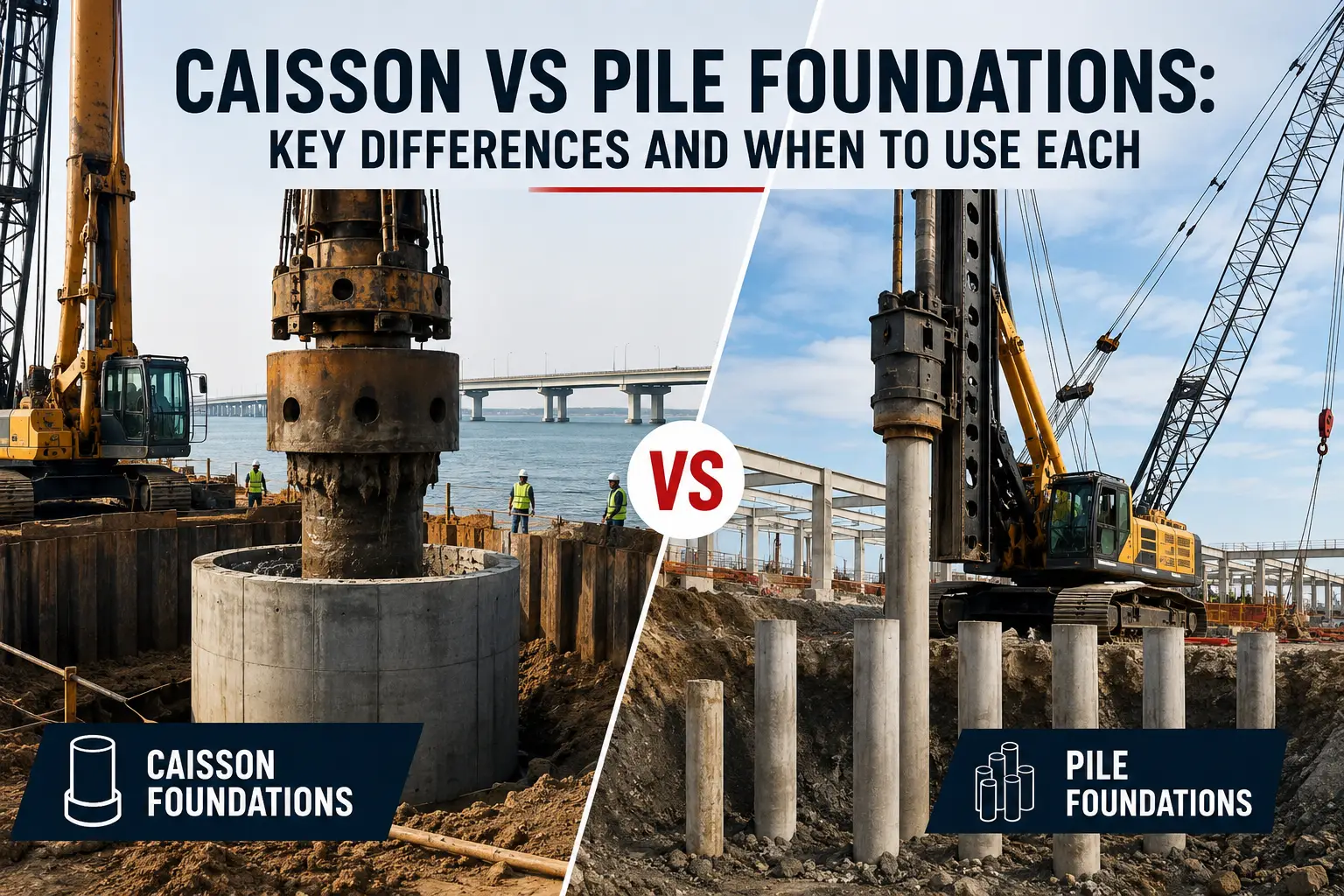
If you’re planning a deep foundation project in Los Angeles, you’ve probably run into the caisson vs pile question. Both support heavy structures, but they aren’t interchangeable, and picking the wrong one can mean higher costs, delays, or a foundation that doesn’t hold up to local soil and seismic conditions.
This guide breaks down what separates a caisson from a pile, how each is installed, and which factors drive the decision on hillside and urban Los Angeles sites.
What Is the Difference Between a Caisson and a Pile?
Caissons and piles are both deep foundation systems. Their job is the same: transfer the weight of a structure down to soil or rock layers stable enough to support it. Where piles and caissons differ is size, installation method, and the type of project each one suits best.
In simple terms, caissons are typically larger drilled shafts. Piles are often slimmer structural elements that may be driven, drilled, or cast into place. That distinction matters more than it sounds, since it affects everything from equipment needs to how much a project disturbs the surrounding site.
| Factor | Caisson | Pile |
| Typical size | Large diameter (often several feet) | Slender, smaller cross-section |
| Installation | Drilled or excavated, then reinforced and poured | Driven, drilled, or cast-in-place |
| Common materials | Steel reinforcement and concrete | Concrete, steel, or timber |
| Best suited for | Single large concentrated loads, hillside lateral support | Repeated support points, varied soil profiles |
| Vibration | Minimal | Can be significant if driven; minimal if drilled |
Caisson Foundations
A caisson is a large-diameter shaft that’s drilled or excavated into the ground, reinforced with steel, and filled with concrete. According to the Federal Highway Administration’s drilled shaft design manual, these shafts typically range from about 2 to 30 feet in diameter and can extend hundreds of feet deep. Because of their size, caissons can carry substantial loads, which is why they show up so often in bridges, high-rise buildings, and hillside homes that need serious lateral support.
Pile Foundations
Piles are long, slender structural members installed by driving, drilling, or casting them into the ground. Depending on the project, piles can be made from concrete, steel, or timber. They’re a common choice where a site needs multiple support points rather than one large load-bearing shaft.
A quick example: a hillside home addition might call for caissons to resist lateral soil pressure and slope movement, while a commercial support structure on flatter ground might use a series of piles spaced across the foundation footprint. When weighing piles vs caissons for a specific site, neither approach is automatically better. It depends on the site and the structure.
One caveat: terminology varies. Some engineers use “caisson,” “drilled pier,” and “drilled shaft” almost interchangeably, while others draw sharper lines between them. If your geotechnical report uses a specific term, it’s worth asking exactly what installation method it means.
How Caissons and Piles Are Installed
The installation process for both systems depends heavily on site conditions, equipment access, and how the soil behaves once it’s disturbed.
Caisson Drilling
Caisson installation starts with drilling or excavating a shaft to the required depth. Once the hole is ready, crews place steel reinforcement and pour concrete to form the finished shaft. In soil that’s loose or where groundwater is a concern, temporary casing or slurry may be used to keep the excavation stable while the concrete is poured.
On Los Angeles hillside lots, soil conditions can shift dramatically over a short distance, so a drilling contractor familiar with the area’s topography can adjust technique before a problem shows up mid-project.
Pile Installation
Piles can be driven, drilled, or installed as cast-in-place elements. Driven piles are pushed or hammered into the ground, which is efficient but generates noise and ground vibration, a real concern on sites near existing structures if vibration isn’t monitored and managed.
Drilled piles produce far less vibration, making them a common choice on sensitive or tightly packed urban sites. The tradeoff is spoils (the excavated soil) that need to be hauled away, something driven piles largely avoid.
Access matters just as much as method. Dense lots and steep hillside properties often can’t accommodate large pile-driving rigs, which pushes the decision toward drilled systems regardless of which option would otherwise cost less.
Factors That Affect the Caisson vs Pile Decision
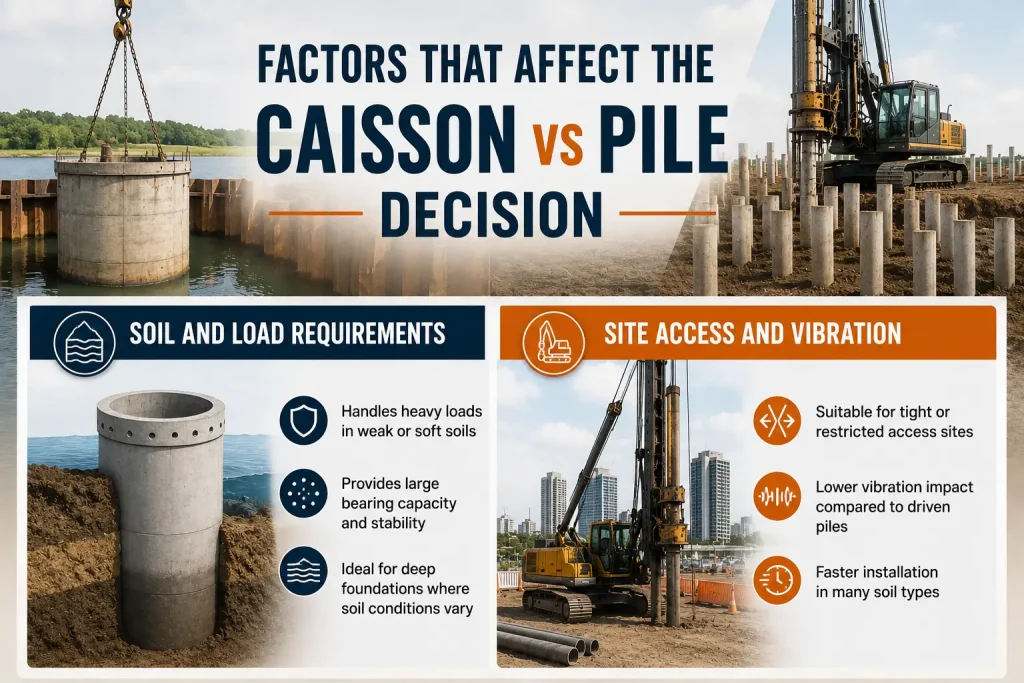
The final call on caisson vs pile almost always comes down to an engineer’s review of the soil report, structural loads, site access, and local building requirements. This isn’t a DIY decision, but understanding the factors helps you have a more informed pile vs caisson conversation with your engineer or contractor.
Soil and Load Requirements
The choice often comes down to a handful of soil and structural factors:
- Bearing depth: how far down stable soil or rock sits
- Soil strength and groundwater: loose or waterlogged soil may need casing or slurry support during drilling
- Lateral loads: hillside sites with slope pressure often favor caissons
- Total structural weight: a single large concentrated load (like a heavy column) often points to a caisson, while repeated, evenly spaced loads may favor piles
It’s worth being direct here: there’s no universal rule that caissons are stronger than piles. Load capacity depends on diameter, depth, materials, and the specific soil at your site, not the foundation type alone.
Site Access and Vibration
A few site conditions tend to tip the decision one way or another:
- Tight lot access: steep or narrow hillside lots often can’t accommodate large pile-driving rigs
- Nearby structures: drilled systems produce far less vibration, reducing risk to neighboring buildings or underground utilities
- Noise restrictions: common in dense Los Angeles neighborhoods where construction sits close to older homes
- Grading and slope: hillside grading can limit which equipment is even physically able to reach the site
A geotechnical report and your structural engineer’s recommendations should guide the final decision. An experienced drilling contractor can also flag access issues an engineer might not catch from plans alone, like whether a rig can even reach the build site.
Final Thoughts
Most articles comparing caissons and piles stop at soil bearing capacity. In Los Angeles, two other factors often decide the outcome first: rig access on steep or narrow hillside lots, and seismic lateral load requirements that can push a design toward drilled caissons even when a driven pile would otherwise work. If you’re planning a hillside build, ask about access constraints early. It can save a redesign later.
Choosing between a caisson and a pile foundation isn’t something to guess at. Whether your project calls for a caisson pile foundation on a challenging hillside lot or a straightforward pile layout on flatter ground, working with an experienced drilling contractor who understands both caisson drilling and pile drilling in LA can help you avoid costly missteps. And if your project also needs temporary support during construction, it’s worth asking your contractor about shoring and drilling options.
FAQ About Caissons vs Piles
Is a caisson a type of pile foundation?
Sometimes, engineers group drilled caissons alongside pile systems in general discussion, but formal engineering references usually separate piles and caissons by size, installation method, and how they carry load.
Which is better: caisson or pile?
Neither is universally better. Weighing pile vs caisson options always comes down to soil conditions, structural loads, site access, and your engineer's design, not a fixed rule.
When are caissons used in hillside construction?
Caissons are common in hillside builds when a structure needs deeper support, added slope stability, or resistance to both vertical and lateral loads from shifting soil.
