
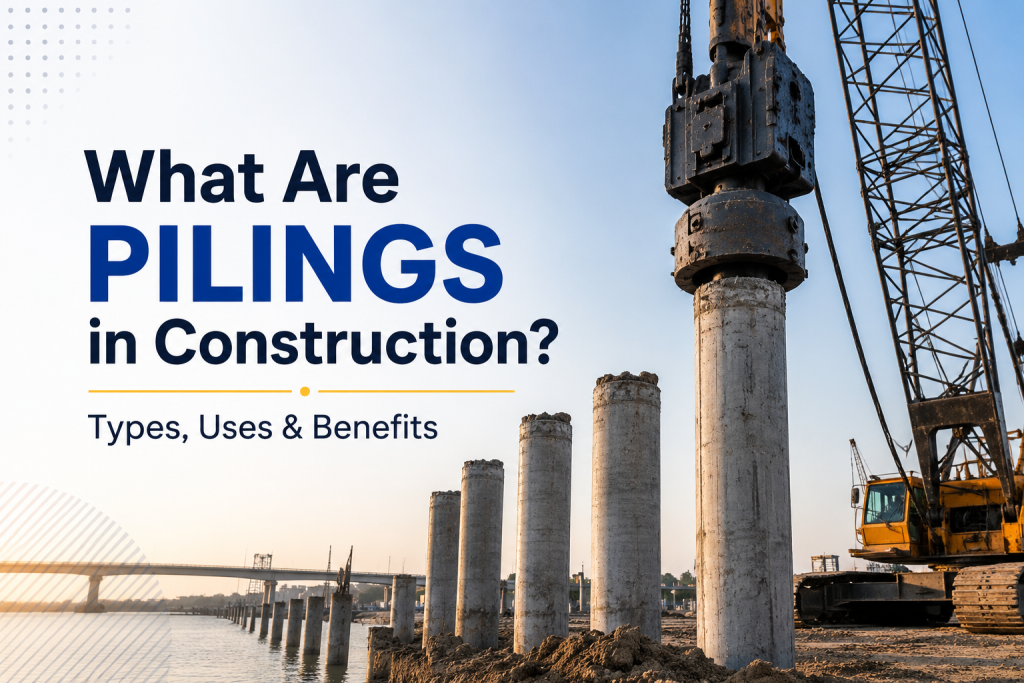
Pilings are long structural elements that are driven, drilled, or cast into the ground to transfer building loads down to stronger soil or rock beneath the surface. When near-surface soil can’t reliably support a structure, piling in construction provides the deep foundation solution that makes the project safe and viable. Understanding what pilings are in construction helps owners and contractors make the right foundation decisions from day one.
The terms “pilings, “” piles, and “pile foundations” are often used interchangeably. A pile is a single structural element. “Pilings” refers to multiple piles working together. A pile foundation is the complete system, including the piles, the pile cap, and the load path they create beneath a structure.
Understanding Pilings in Construction
Pile foundations are slender, elongated structures made of steel or reinforced concrete, designed to transfer loads through weak, compressible material to stiffer soil or rock at greater depth. The origins of piling date back thousands of years, with evidence of timber piles in Switzerland dating to around 6,000 years ago. Modern construction projects still rely on the same core principles, with significantly advanced materials and equipment.
Basic Purpose
The basic purpose of pilings is to bypass weak surface soil and transfer structural loads to stable ground layers below. Where shallow foundations would shift, crack, or settle, pile foundations hold a structure firmly in place by reaching the competent material beneath the problem zone.
Piles vs. Pilings
A pile is a single, deep structural element. ‘Pilings’ is the collective term for a group of piles installed beneath a structure. In practice, most foundation systems use multiple piles spaced and designed according to the specific load requirements of the building above.
Why Pilings Are Used in Construction
Pilings are used when shallow foundations aren’t sufficient due to weak soil, heavy structural loads, sloped terrain, water exposure, or settlement risk. A qualified drilling contractor evaluates site conditions and determines whether a deep foundation solution is needed before design work begins.
- Weak Surface Soils: Weak surface soils cannot support standard shallow foundations. When near-surface ground is soft, loose, or saturated, pilings bypass that layer and transfer loads to stable soil or rock at depth.
- Heavy Structural Loads: Large buildings, bridges, and industrial structures generate loads that surface soil simply can’t accommodate. Piling in construction allows those loads to reach deeper, stronger ground capable of handling the structural demand.
- Settlement Control: Differential settlement causes structures to shift unevenly over time, leading to cracking and structural damage. Pile foundations anchor a building to stable ground layers, significantly reducing settlement risk throughout the structure’s life.
How Pile Foundations Work
Pile foundations transfer structural loads through end bearing, skin friction, or a combination of both. Engineers select pile depth, diameter, spacing, and material based on geotechnical reports and structural load requirements.
As noted in the International Journal of Geotechnical Engineering (2023), “Pile foundations not only transmit the superstructure loading to the stronger and stiffer subsoil beneath, but they also assist in reducing the settlements of infrastructure.”
Engineers determine which load transfer approach to use based on geotechnical reports, then design pile depth, diameter, spacing, and material accordingly.
End-Bearing Piles
End-bearing piles transfer the full structural load through the pile tip directly to a firm stratum or rock layer at depth. The pile acts as a column, bypassing all weaker material above and delivering the load to a dense, stable layer below.
Friction Piles
Friction piles derive their load capacity from the adhesion and friction that develop along the pile shaft as it passes through the surrounding soil. Rather than relying on what’s at the bottom, the pile uses surface contact along its full length to carry the structural load.
Combined Load Transfer
In many applications, piles rely on both mechanisms at once. The shaft develops friction resistance along its length, while the tip bears against a denser layer below. Engineers account for both contributions when calculating total pile capacity.
Common Types of Pilings in Construction
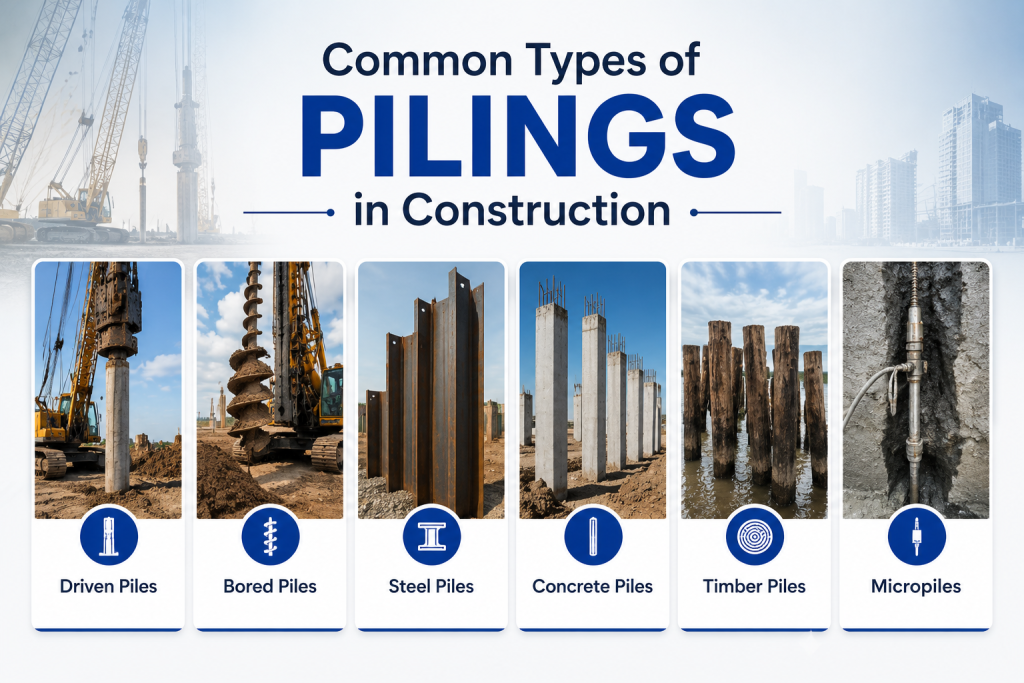
The right pile type depends on soil conditions, structural loads, site access, and environmental sensitivity. Each type has specific installation methods and conditions where it performs best.
Driven Piles
Driven piles are pre-manufactured from steel, concrete, or timber and hammered or vibrated into the ground using a hydraulic hammer or pile driver. They require no excavation and are well-suited for fast installation across large areas.
Bored Piles
Bored piles are constructed by drilling a hole into the ground, inserting a steel reinforcement cage, and filling it with concrete. Rotary bored piling produces significantly less noise and vibration than driven methods, making it the preferred choice in urban environments.
Steel Piles
Steel piles, including interlocking steel sheet piles, are used in high-load applications and difficult soil conditions. Steel sheet piles are driven side by side to form a continuous underground wall that retains soil or water on waterfront and excavation projects.
Concrete Piles
Concrete piles are among the most widely used in modern construction projects due to their durability and structural strength. They can be precast concrete piles driven into position or cast-in-situ piles formed by pouring concrete directly into a drilled hole.
Timber Piles
Timber piles, also known as wood piles, are one of the oldest piling materials in recorded history and are still used in marine environments, temporary works, and light-load applications. They are vulnerable to rot and decay, limiting their use in permanent, heavy-load construction.
Micropiles
Micropiles are smaller-diameter drilled piles used where site access is restricted or existing structures require additional foundation support. They are installed using compact piling rigs and are a reliable solution for retrofit and underpinning work.
Where Pilings Are Commonly Used
Pile foundations are used across a wide range of construction settings, from residential homes to major infrastructure projects.
- Buildings and Homes: Structures built on soft soil, expansive clay, or fill material often require piles drilling in Los Angeles to achieve the bearing capacity that shallow foundations can’t provide.
- Hillside Sites: Sloped terrain introduces vertical and lateral load challenges that shallow foundations aren’t designed to handle, and pilings anchored to stable ground layers provide the stability hillside structures need.
- Marine Structures: Piers, docks, seawalls, and waterfront buildings depend on pile foundations to remain stable in saturated, shifting, or wave-affected ground conditions.
- Bridges and Infrastructure: Bridges and large infrastructure projects rely on deep foundation solutions to safely transfer enormous loads into the ground, particularly where soft ground or waterways make shallow foundations impractical.
Benefits of Using Pilings
Pile foundations deliver four core advantages that matter most to owners building on challenging sites.
- Stronger Load Support: Pile foundations access deeper, denser soil and rock layers with far greater load-bearing capacity than surface soil, allowing structures to carry heavier loads safely over time.
- Improved Stability: By anchoring a structure to stable ground below seasonal moisture changes and surface movement, pilings significantly reduce settlement, shifting, and structural damage.
- Better Site Adaptability: Pilings make construction viable on sites that would otherwise be unsuitable, including waterfront land, hillside terrain, loose sands, and areas with high water tables.
- Reduced Installation Disruption: Low-impact techniques such as continuous flight auger (CFA) piling and helical piles produce minimal noise and vibration, making modern piling methods practical even in noise-sensitive and environmentally sensitive sites where traditional driven piling would cause unacceptable disturbance.
Factors That Affect Piling Selection
The right piling system depends on geotechnical reports, structure type, site access, groundwater, noise sensitivity, and local code requirements. Pile design should always involve licensed engineers and experienced foundation contractors. And Semper Drilling works with licensed engineers to get every one of these right.
| Factor | What It Means for Piling Selection |
| Soil Conditions | Soil type, strength, and layering determine whether end-bearing or friction piles are needed and how deep they must go. |
| Structural Loads | The weight and distribution of the structure above determine pile diameter, spacing, depth, and required material. |
| Site Access | Restricted access or low overhead clearance limits rig size and may require micropiles instead of larger bored or driven piles. |
| Installation Impact | Urban or noise-sensitive sites require low-impact methods such as CFA piling to reduce disturbance to neighboring structures. |
Pilings vs. Shallow Foundations
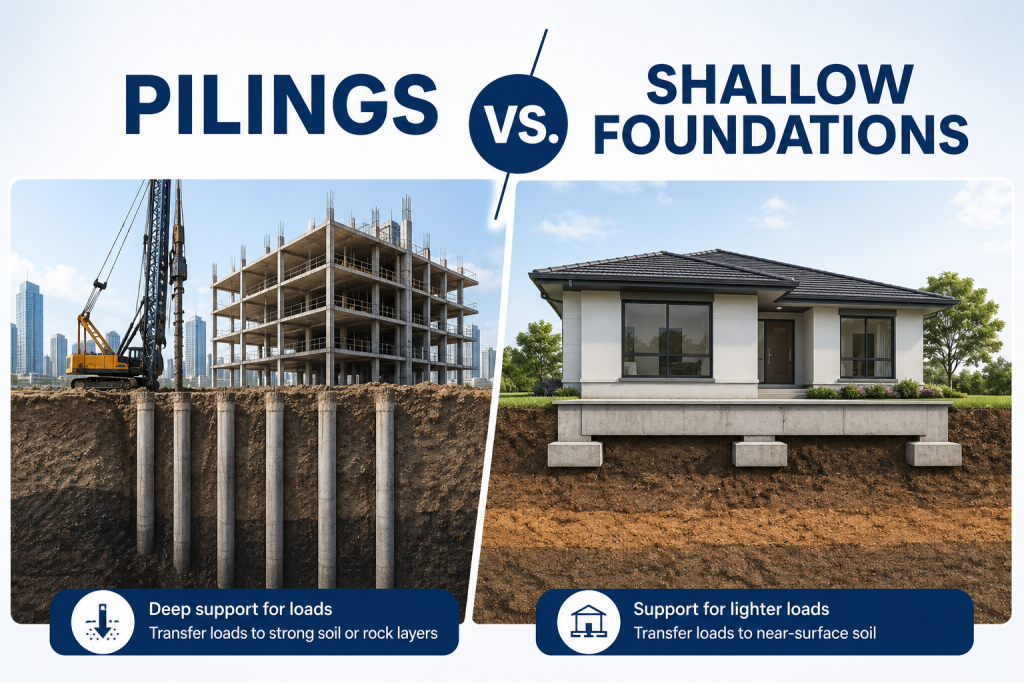
Not every project needs pilings. When surface soil is strong and consistent, shallow foundations are the more practical choice.
Shallow Foundation Use
Shallow foundations, including slab-on-grade, spread footings, and mat foundations, distribute a structure’s load across near-surface soil and work well when ground conditions at shallow depth have adequate bearing capacity and low settlement risk.
Deep Foundation Use
Deep foundations are required when surface soil is too weak, too variable, or too compressible to carry structural loads reliably. Pilings bypass the problem layer and deliver loads to stable soil or rock below, making them the engineering requirement on sites with poor ground conditions, heavy loads, or water exposure.
When to Talk to a Drilling or Foundation Contractor
If your project involves poor soil reports, sloped terrain, proximity to water, heavy structural loads, or structures nearby that could be affected by ground movement, a professional evaluation is essential before making foundation decisions.
Early Project Planning
Engage a geotechnical engineer and foundation contractor early so that the foundation design is based on actual ground conditions rather than assumptions. Early evaluation prevents costly corrections later and ensures the piling system meets the site’s actual requirements.
Contractor Coordination
Successful piling operations require coordination between the property owner, structural engineer, geotechnical engineer, drill rental in Los Angeles, and foundation contractor executing the work. Local permitting authorities will also have requirements that must be addressed before construction begins, and aligning all parties early keeps the project on schedule.
Semper Drilling coordinates across all of these touchpoints, from early site evaluation through to installation.
FAQs About Pilings in Construction
How deep do pilings go?
The depth of pilings depends on soil conditions, the structure's load requirements, and the findings of a geotechnical investigation, with some piles extending only 10 to 15 feet and others reaching 100 feet or more to reach competent bearing material.
Are pilings the same as foundations?
Pilings are not the same as a foundation. They are one component of a deep foundation system, which also includes the pile cap and the structural connections that distribute the building's load into the pile group below.
What is the difference between driven piles and bored piles?
Driven piles are pre-manufactured and hammered or vibrated directly into the ground without excavation, while bored piles are constructed by drilling a hole, then filling it with reinforcement and concrete. Driven piles install faster, and bored piles produce far less noise and vibration.
How do I know if my project needs pilings?
The most reliable way to determine whether pilings are needed is to commission a geotechnical investigation and have the results reviewed by a licensed structural or foundation engineer, particularly if the site has soft soil, a slope, water exposure, or a history of settlement.
